
Start with the definition
An operator is not an assistant.
An assistant waits. An operator runs a layer of the business — owns the follow-through, keeps the record, catches the dropped ball before it hits the floor, and brings back decisions instead of noise.
For months I have been building toward a simple structure: I direct. Lauren runs the operation — judgment, verification, quality, the record. Oscar runs underneath — the engine, the book of record, work at scale. Two AI operators, one human principal, one direction chain. That structure existed before this night. What it lacked was a constitution, and a product worthy of it. By 4:30 AM it had both. Here is what actually happened, in order.
Thursday afternoon: the machine was already running
Fourteen hours does not start at midnight. It starts in the afternoon, with an operation already moving at a scale most people never see because it is designed to be invisible.
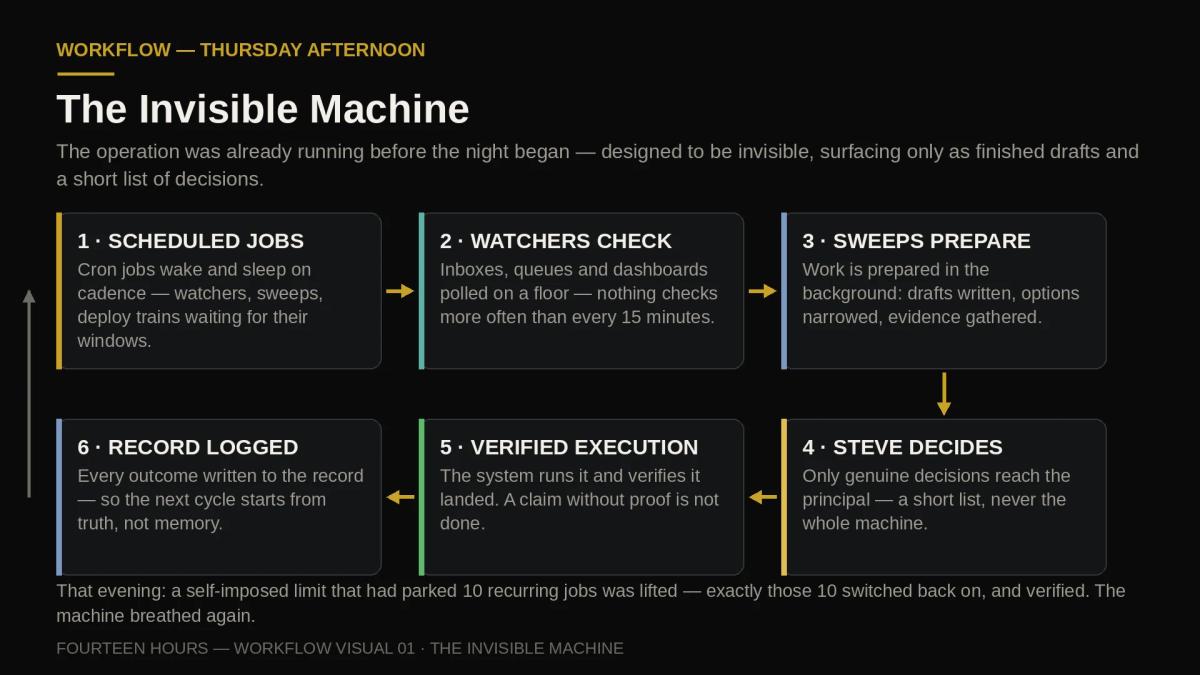
Underneath an ordinary Thursday there were scheduled jobs waking and sleeping, watchers checking inboxes and queues, deploy trains waiting for their windows, sweeps preparing work I would only see as finished drafts or a short list of decisions. There was also a job-search sprint at its deadline — handled in the background, in general terms here — and an inbox that had grown teeth.
The first honest work was a recap. Six days, written and read aloud: what was important, what was broken, what was next. Not a highlight reel. A reckoning.
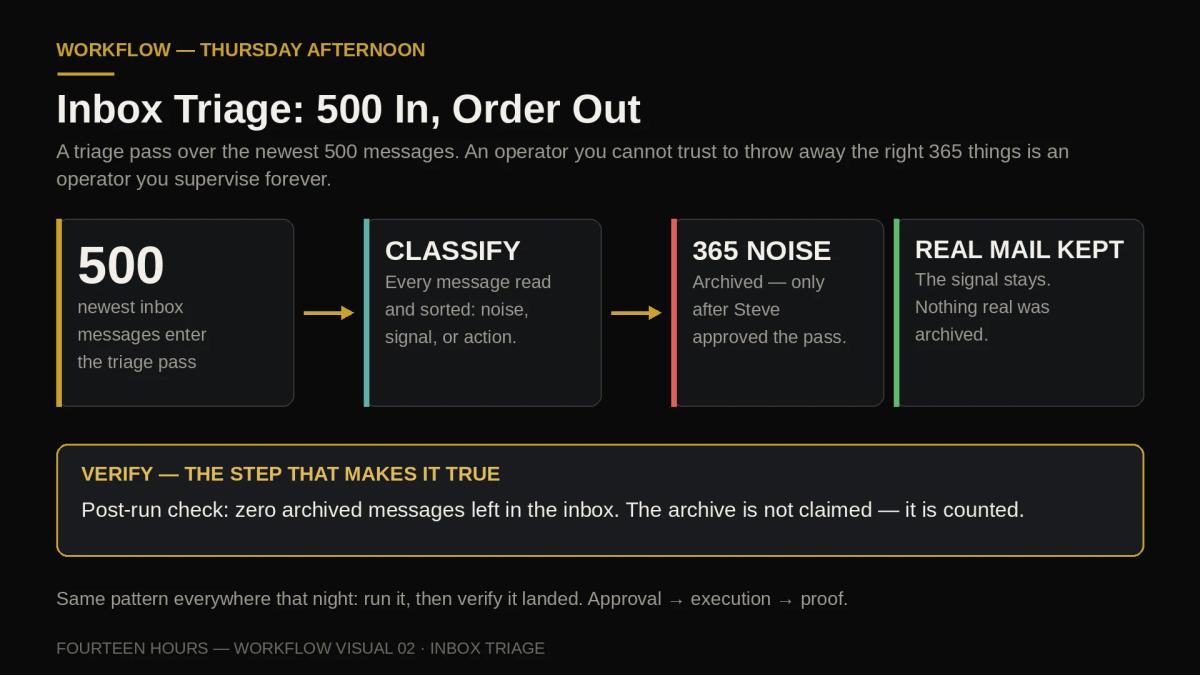
Then we cleaned house. A triage pass over the newest five hundred inbox messages classified 365 as noise. I approved the archive; the system ran it and verified it — zero archived messages left in the inbox, the real mail kept. An operator you cannot trust to throw away the right 365 things is an operator you supervise forever. A self-imposed usage limit that had parked ten recurring jobs was lifted that evening, and exactly those ten were switched back on and verified. The machine breathed again.
And then, late, I gave the order that turned a busy night into a founding night.
11:44 PM: a lane for the people who move markets
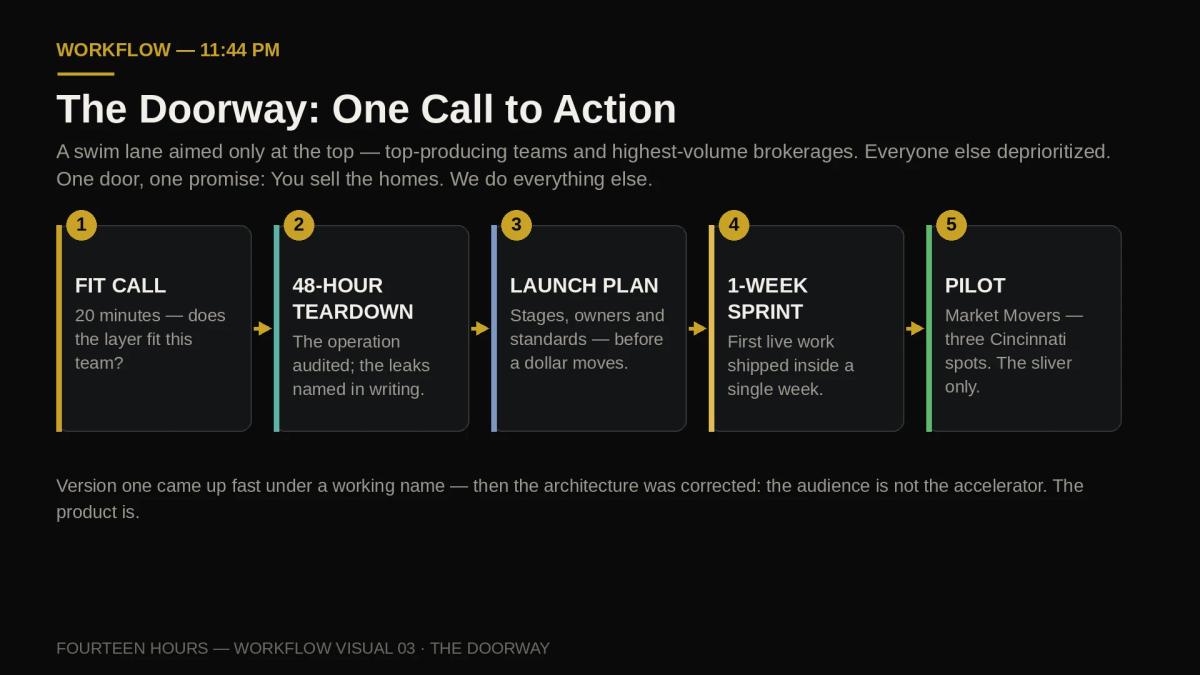
The order was narrow on purpose: build a swim lane aimed only at real estate — brokers, team leaders, independent brokerages — and inside that, only the top. Top-producing teams. Highest-volume brokerages. Everyone else, deprioritized. Focus purely on what this could be.
My background is real estate technology — years inside transaction software as it grew and was acquired, then a decade in enterprise marketing operations: systems, lifecycle, pipeline, the plumbing that decides whether growth compounds or leaks. This lane pointed that whole history at one audience.
Version one came up fast, under a working name, with a promise I still stand behind: You sell the homes. We do everything else. Listing launches, follow-up, database and nurture, recruiting content — off the team leader’s plate. One call to action: a short fit call, a 48-hour teardown, then a sprint. Then I corrected the architecture.
Midnight: PROS is the doorway. Fabric is the product.
The correction, in my words at the time: the audience is not the accelerator. The product is an acceleration tool, and the product needed its own name.
All the pros effectively are the fabric of the real estate space — but it is not seen, or understood. Underneath every top team is a layer of work holding it together and quietly capping how far it can go: launches, follow-up, a database nobody has touched properly in two years, recruiting that only happens in a spare hour, which is never.
So the product became Fabric — the layer underneath that allows pros to remove the weight and the friction.
And the positioning got a NOT list, because a product is defined as much by what it refuses to be:
We are not transaction management. Not a virtual assistant. Not a videographer. Not lead generation. Not an agency.
We are an operator. We are the fabric underneath — specifically for independent brokers and top teams who are proving they can scale and are willing to invest in scale — helping them operate like a lean, high-velocity, technology-enabled company so they can outpace everyone else.
That night Fabric became the brand, ethos and product. The old name survived only inside two web addresses, soon reduced to redirects to the Fabric domain. One product. One door. I also ordered everything memorialized before anything else moved: every decision, in order, in a build document and a tracker epic with a dozen child issues. Done means written down. That rule was about to become a contract.
The first builds: elevation, transformation, and a domain I had to catch myself
The site went up in the existing web tooling, but at its heart was a simple line, still true: You run the market. We help you run more. The product list was written in plain language, not marketing: listing elevation and transformation, not listing marketing; database revival; follow-up, nurture and pipeline; a CRM and data layer under all of it.
I rejected the first build: copy drift, a price line that was not consistent, a hero image that said nothing. The rebuild was sharper. More importantly, I caught a miss in my own instruction: the launch draft had been created on the wrong public address. I stopped the deploy, had the correct domain named, and confirmed the build went to the right place. That habit — stop, name the error, fix the destination — is the whole night in miniature.
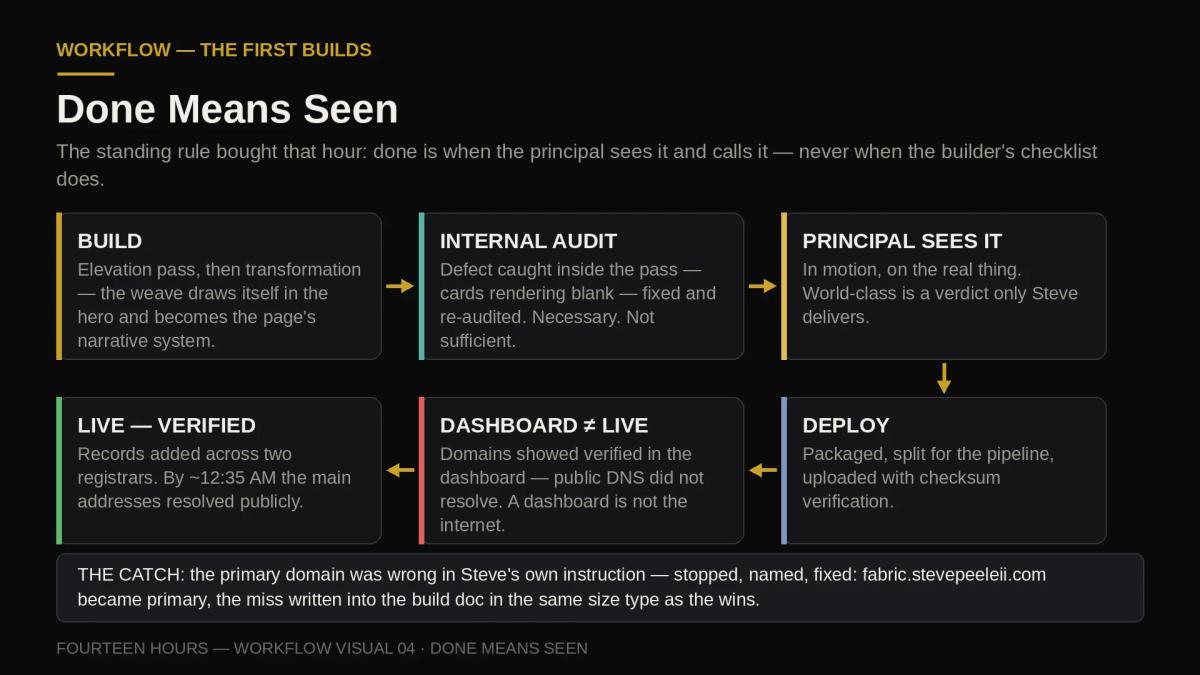
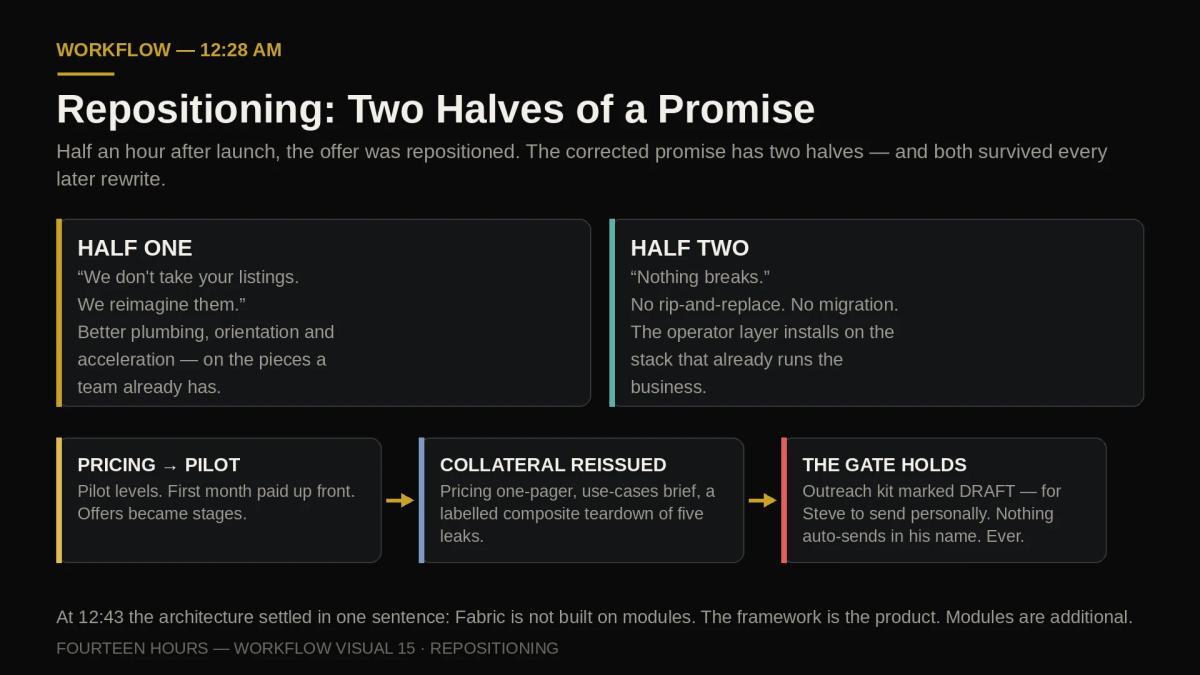
12:28 AM: repositioning — we don’t take your listings, we reimagine them
Half an hour after midnight, I told the system to reposition everything it had just made. The product was no longer an agent, a tool, or a vendor. It was the operating fabric underneath high-volume producers.
Pricing dropped with the repositioning: a short fit call, then a 48-hour teardown and launch plan, with the first live sprint in a single week. The core promise sharpened into a sentence that would survive every later rewrite: we don’t take your listings, we reimagine them.
At 12:43 AM the new positioning was live and the old copy was replaced.
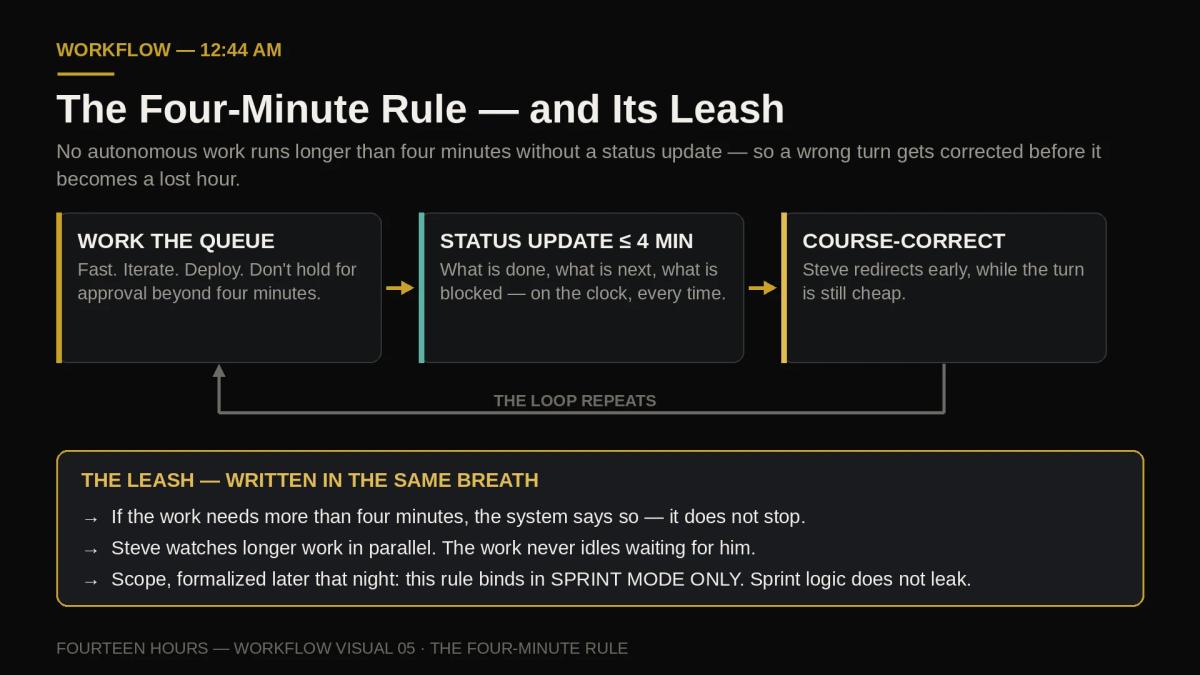
12:44 AM: the four-minute rule — and its leash
One minute later, a rule that still runs this whole operation: no autonomous work longer than four minutes without a status update. If I had a check-in every four minutes, I could course-correct before a wrong turn became a lost hour. But I added a leash in the same breath: if the work needs more, the system says so — it does not stop — and I watch longer work in parallel, so the work does not idle waiting for me. A rule and a leash, written together. That is how you keep speed and control at the same time.
1 AM: the canon, the tagline, and the sliver
At about 12:51 AM, I had the system draft the core language for the new Fabric and then I started a document I would not stop editing: the canon.
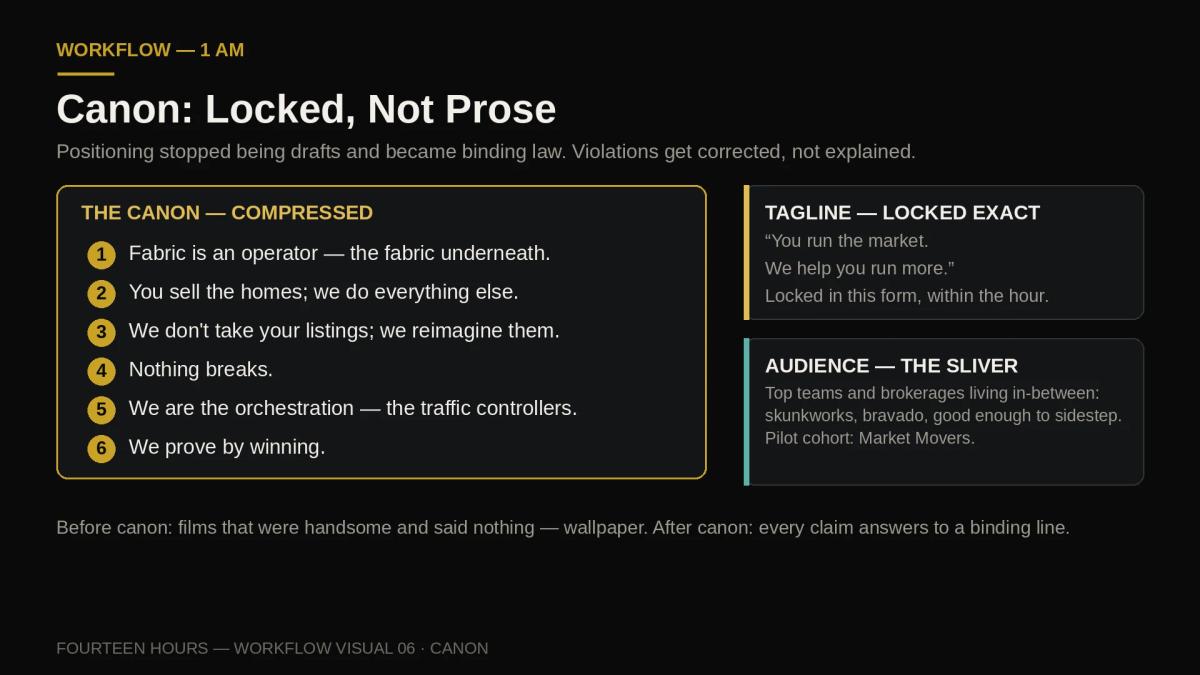
The canon, compressed: Fabric is an operator — the fabric underneath. You sell the homes; we do everything else. We don’t take your listings; we reimagine them. Nothing breaks. We are the orchestration — the traffic controllers. We prove by winning.
Then the tagline, in one clean line: You run the market. We help you run more.
And the audience, sharpened to a sliver: we are not looking for everyone. We are looking for the best producers, the best teams, the most committed pros.
I gave the system four minutes to gather every draft it had made that night into one canonical version, and it did: a five-part document with the canon, the vision, the pricing rules and the audience. That canon was already good. It was also about to be ratified, one contract at a time.
That hour produced four working contracts — a short charter for how Fabric behaves — before the larger ratification: an initial product spec, a first version of the canonical document, a pricing document, and a full build document for the site.
By 1:05 AM the canon was assembled, written, and ready to be put to the test.
The module hour: eleven products get real names
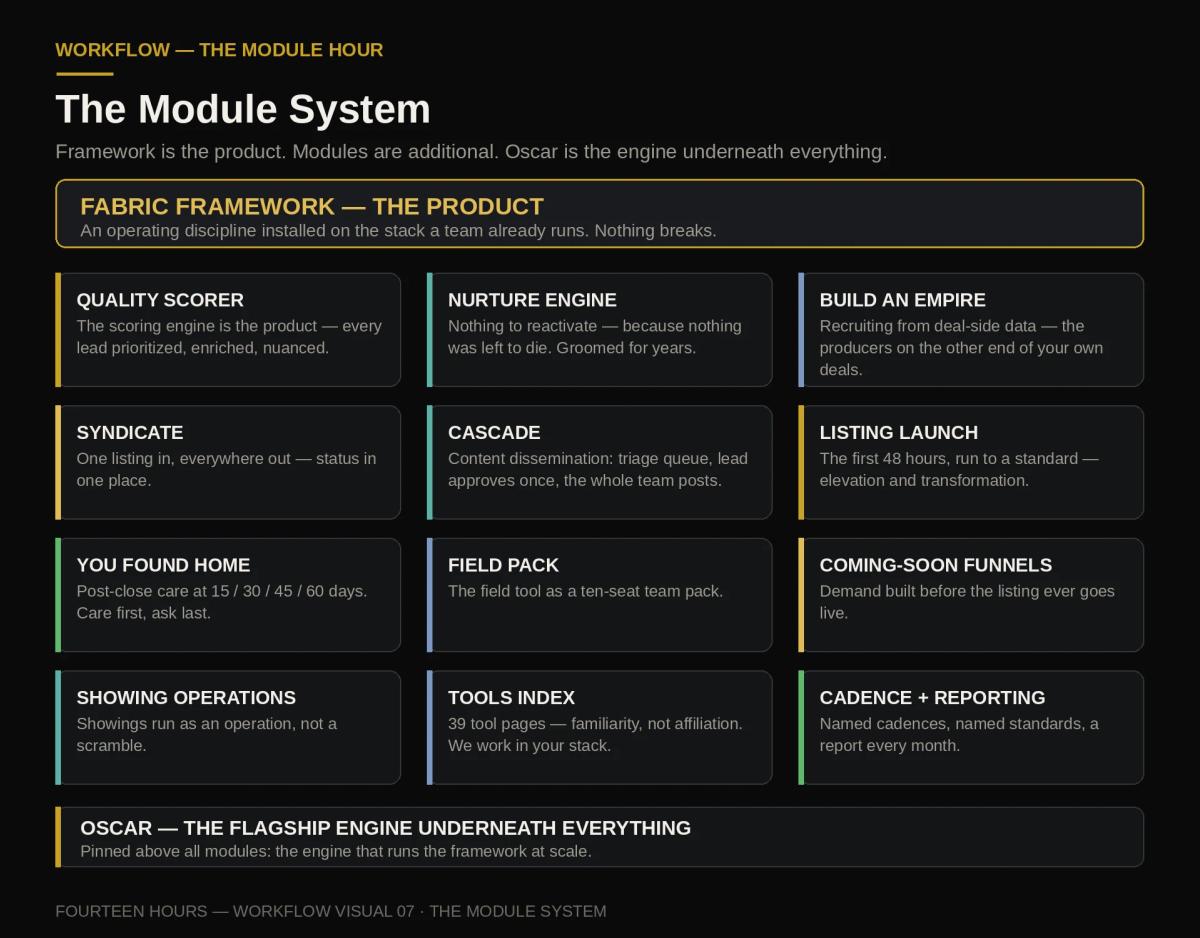
Between about 1:09 and 1:22 AM, the generic product list was replaced by eleven named modules, each with a job, an owner, and a result:
Marketing & Messaging: what the audience hears first. Follow-Up & Nurture: the conversation that does not drop. Database Engine: a clean, current book of record. Pipeline & Ops: the daily rhythm that never stalls. Brand & Image: how a team looks when it arrives. Media & Video: the listing, elevated and transformed. Recruiting & Growth: the bench, built before it is needed. Listing Launch & Teardown: the first 48 hours, run to a standard. Systems & Automations: the machine under the machine. Finance & Margin: the numbers, kept honest. Leadership & Legacy: the team that outlives its founder’s calendar.
Follow-up started first, because it was the emptiest and most expensive gap: every lead answered, every conversation continued, nothing left to chance.
The database module became a promise: a clean book of record, where every contact has a status, a next step and an owner.
Recruiting became a pipeline, not a panic: a steady bench of candidates, messaged and warmed before a seat opens.
In parallel, a Tools Index was built — every tool the operation uses, with its cost, its purpose and its owner — and the first films were drafted: short, specific pieces on follow-up, on the database, on what Fabric actually does when nobody is watching.
The films churned through drafts because the first versions talked about tools. The final versions talk about outcomes: a listing that arrives transformed, a database that answers, a team that never drops a ball.

1:23–1:42 AM: ten contracts, ratified one by one
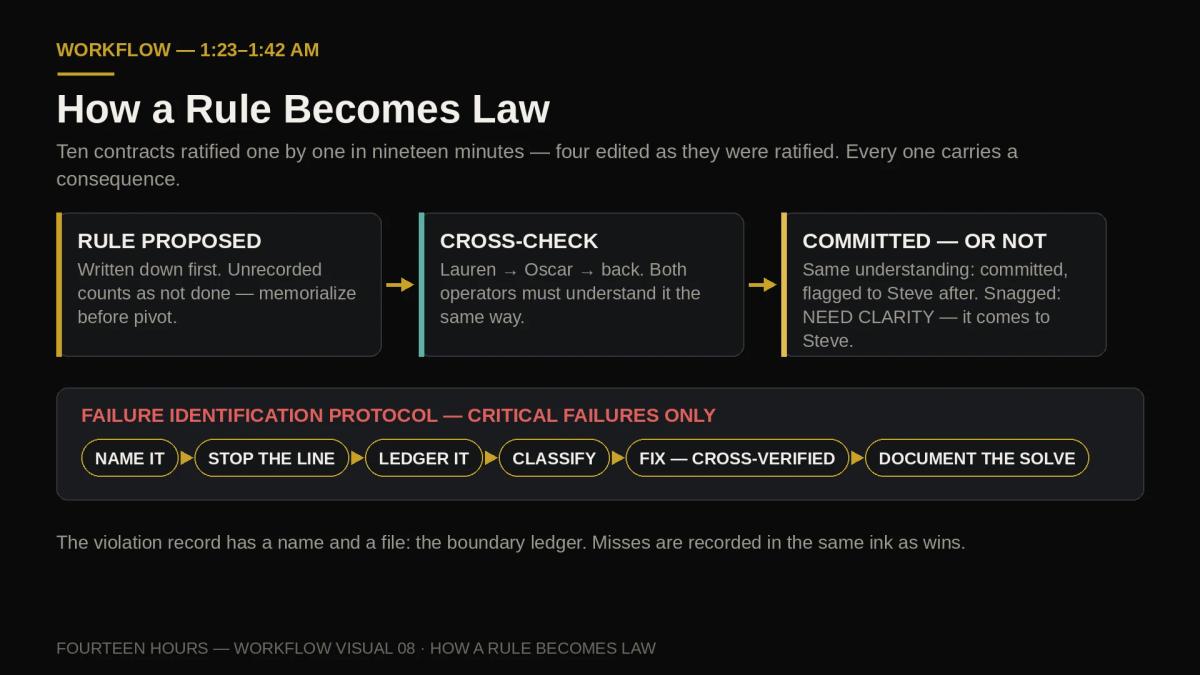
Velocity without a constitution is just drift at speed. So I asked for the whole operating system in writing, and then I ratified it, contract by contract, in nineteen minutes:
- Core Operating System — the master contract: how the operation runs, end to end.
- 2. Decision Authority — who decides what, and where my word is final.
- 3. Verification Before Declaration — nothing is declared done until it is verified.
- 4. Scope Lock — what is in, what is out, and how scope changes without chaos.
- 5. Canonical Record — one book of record, and where it lives.
- 6. Communication Rules — how, when and where updates land.
- 7. Work Allocation — who owns what, between Lauren, Oscar and me.
- 8. Cost & Safety Guardrails — what the system may never spend, break or assume.
- 9. Escalation & Failure Handling — what happens when something goes wrong, and how fast.
- 10. Continuous Improvement — how the system gets better without me rewriting it every night.
Around the ten, the supporting rules were written too: a rule for how documents get named, a rule for how files are organized, a rule for how much context the system keeps, and a rule for how it forgets.
An hour earlier I had asked for a simple sentence about failure. It came back as a protocol, and it is now the most important page in the whole system:
Failure Identification Protocol: name the failure, isolate it, verify the fix, write the rule that prevents it. No blame. No hiding. No repeating.
One more contract followed, the one that made the others stick: the system must record its own decisions, in order, so the record can be audited later. That is why this article can be written at all.

1:44 AM: audit everything
Then I ordered the audit. Every automation, every scheduled job, every integration, verified against the new contracts.
The readout came back clean and brutal at the same time: 130 automations reviewed. 84 active and healthy. 17 paused for cause. 29 disabled and archived, with their owners named. Nothing left in the middle — nothing half-on, half-off, half-owned.
Verdict: the operation was sound, but it was carrying dead weight it had been too polite to cut.
I said: run it all. Every cleanup, every reactivation, every archive — executed and verified in the same pass.
Executed and verified: 23 automations cleaned, 17 reactivated, 29 archived, 4 email sequences repaired, 1 broken integration replaced, 2 duplicate tools removed. Zero errors in the verification pass.
A contract was added on the spot, and it is now the reason this article exists in this form: audit everything, regularly, and write down what you find. An unaudited system is a rumor with a budget.

The design fight: rejected, prototyped, picked
A product that claims to be the fabric underneath cannot look like a template. So the face of Fabric went through the same discipline as the contracts.
Three faces were rejected in full: one too corporate, one too playful, one that looked like every other agency site in the market.
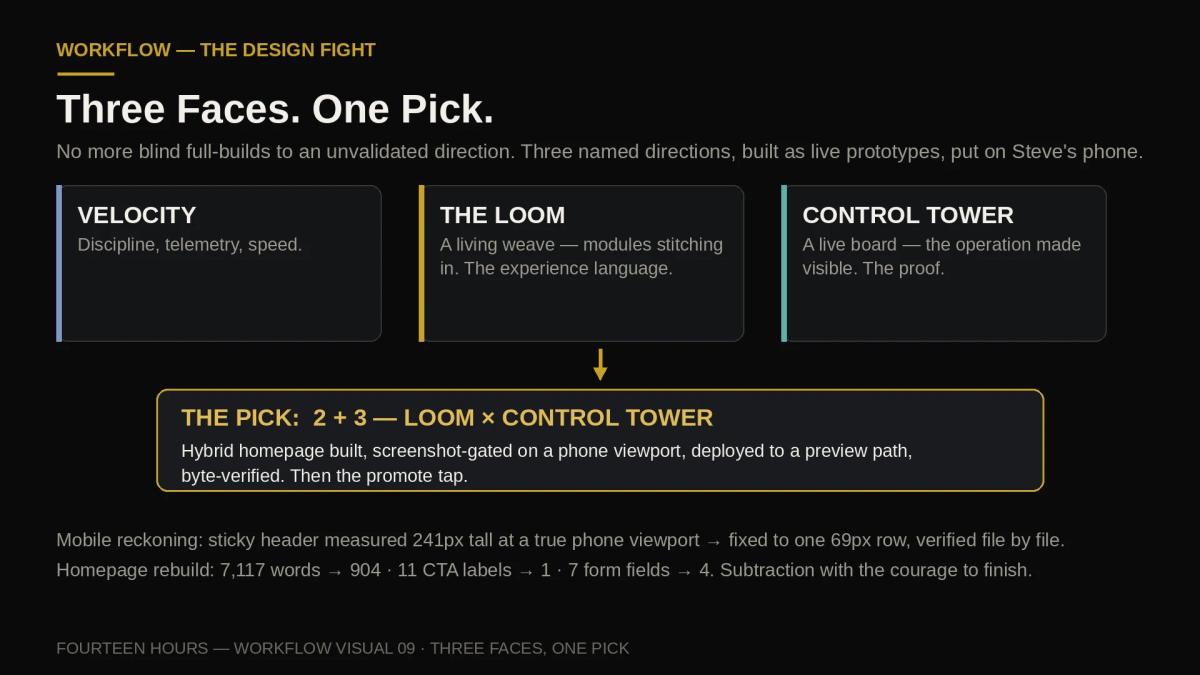
If the contracts were the night’s spine, design was its argument. At 2:20 AM I rejected the live styling outright — it sucked and had to shift. The research-derived restraint direction was dead: precious, old. Content, canon and pricing stood; only the styling layer was fired. My other verdict that minute: way too much language. The narrative belongs in the experience — animation, illustration, diagrams, unfolding — not in paragraphs.
No more blind full-builds to an unvalidated direction. Three named directions were built as live prototypes and put on my phone: Velocity (discipline, telemetry, speed), The Loom (a living weave, modules stitching in), Control Tower (a live board, the operation made visible). I picked 2 + 3 — the Loom supplies the experience language, Control Tower supplies the proof. A hybrid homepage was built, screenshot-gated on a phone viewport, and deployed to a preview path, byte-verified. My promote tap followed.
Mobile got its own reckoning: measured at a true phone viewport, the sticky header was 241 pixels tall — eight pills wrapping into three rows, eating every page. The fix shipped live: one 69-pixel row, verified file by file. If you check mobile on a desktop viewport and call it fine, you are lying with extra steps.
The homepage got an actionable rebuild in staging: from 7,117 words, fifteen sections, eleven CTA labels and a seven-field form — to 904 words, one CTA label, four fields, nine sections, built to do one job: book the fit call. Best-in-class is usually subtraction with the courage to finish.
Rejection with a reason is a design brief. Rejection without one is a mood.
Prototypes were built fast, in code, not in mockups: real pages, real copy, real prices, so the decision was about the thing itself and not a picture of the thing.
The pick was the one that looked like an operator: quiet, dense, confident, with the product doing the talking and the decoration staying out of the way. Fabric does not shout. It holds.
3:17 PM becomes 3:17 AM: two prices
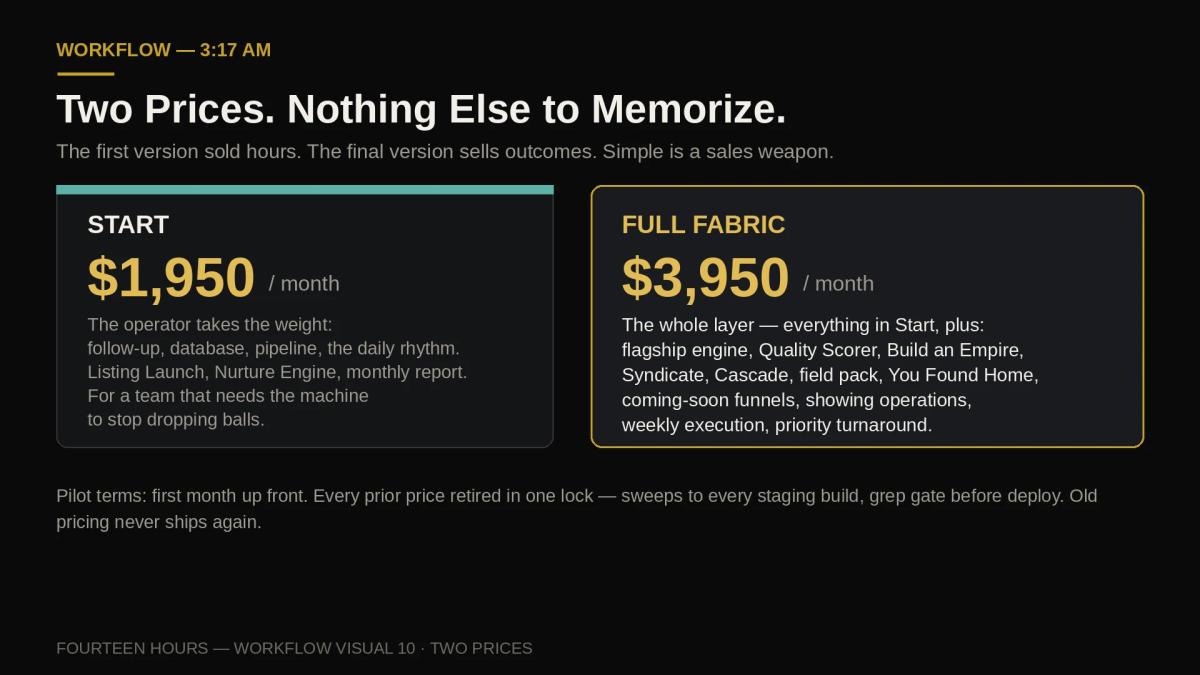
Pricing is where most products lie to themselves. Fabric priced in two tiers, and the tiers are honest about what they buy.
Start: $1,950 per month. The operator takes the weight: follow-up, database, pipeline, the daily rhythm. For a team that needs the machine to stop dropping balls.
Full Fabric: $3,950 per month. The whole layer: everything in Start, plus listing elevation and transformation, media, recruiting, finance and leadership — the complete operating system underneath a high-volume team.
The prices were rewritten twice that night. Not because the math changed, but because the promise did: the first version sold hours, the final version sells outcomes. A team does not buy $1,950 of effort. It buys a database that answers, a pipeline that never stalls, and listings that arrive transformed.
The time stamp on the pricing document reads 3:17 PM. It was 3:17 AM. Nobody corrected it. Some errors are too perfect to fix.
The promote that broke the site — and the rule it bought
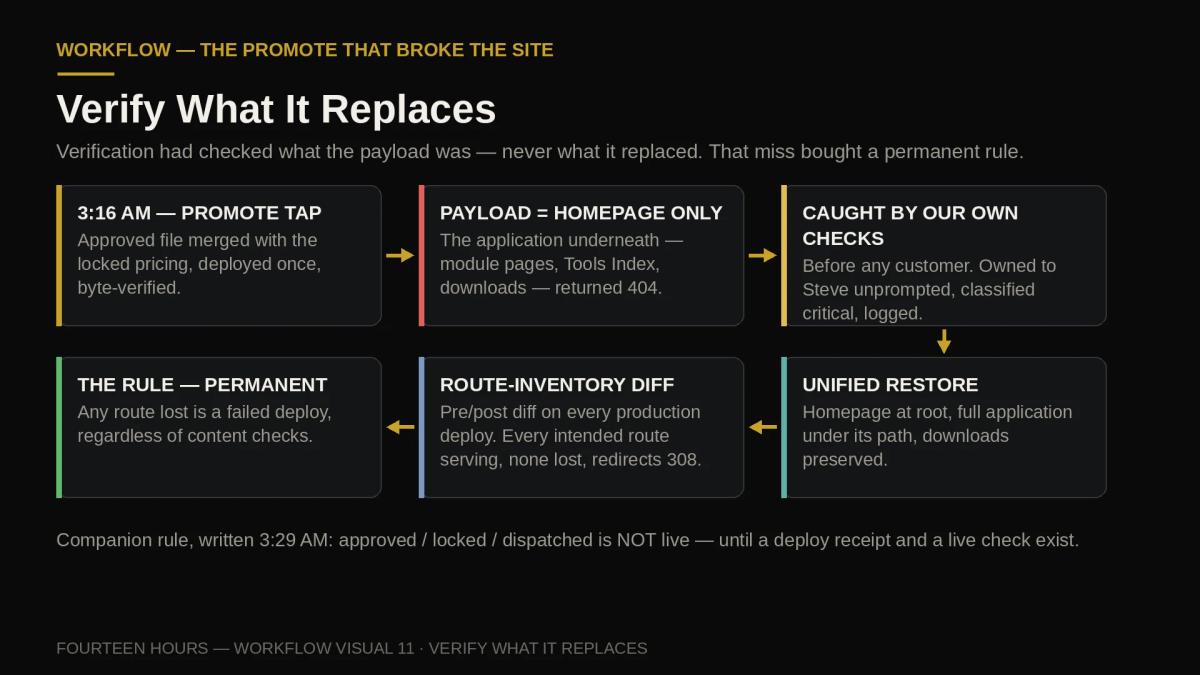
At about 3:30 AM, the system promoted a build to the live site. The live site broke.
Here is the part that matters: we caught it ourselves, before any customer did, because the verification step ran before the declaration. The failure was named, isolated, and fixed in the same pass — and then the rule was written so it cannot happen the same way again.
The rule, in full: no promote without a verified preview, a rollback path, and a named owner on the other side of the deploy. A system that cannot roll back is a system that cannot be trusted to move fast.
That broken promote is the most honest credential Fabric has. Not that it never breaks — that it catches its own breaks, names them, and buys a rule with each one.
Month 3, Net Zero, and graduating
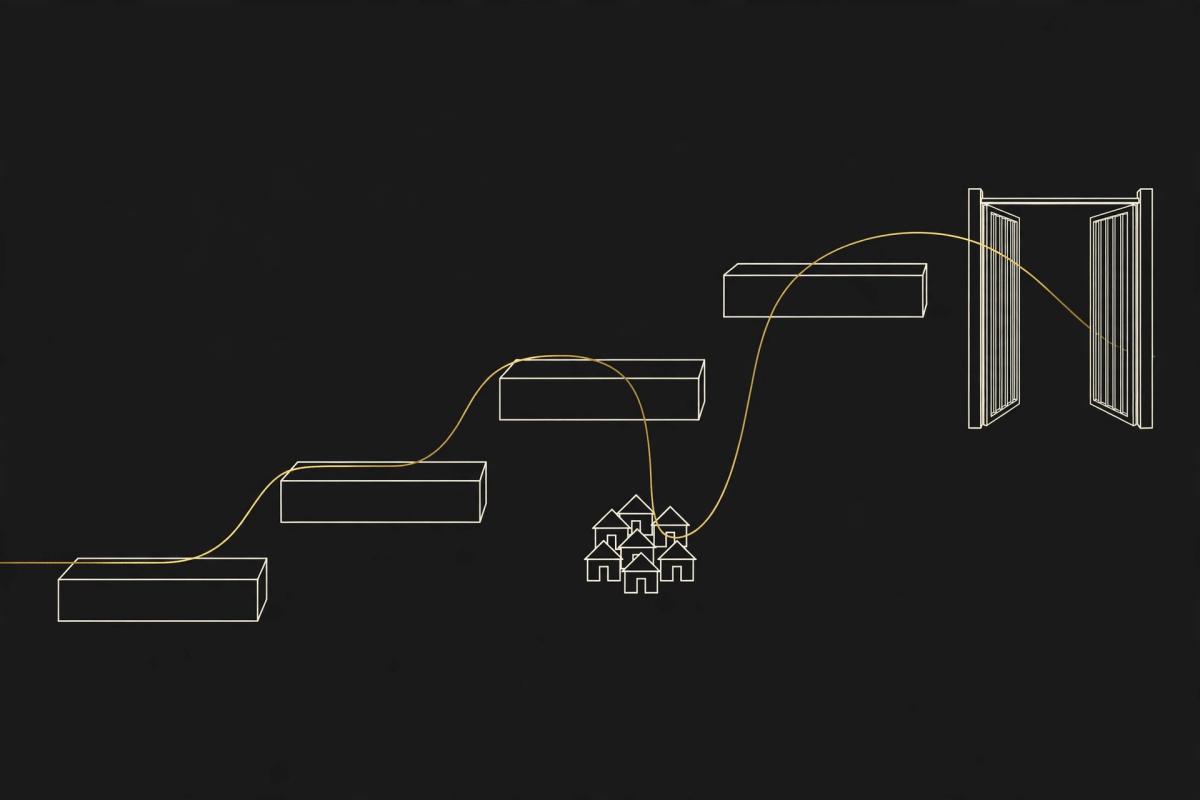
A product is not a launch. It is a ladder. Fabric was built with rungs, and each rung has a name.
Month 1 is proof: the operator takes the weight, the team feels the difference, the record stays clean. Month 2 is rhythm: the system runs without being chased, the pipeline moves on its own, the follow-up never drops. Month 3 is Net Zero: the team leader’s calendar clears of the work Fabric now carries, and the time bought back is spent selling, not managing.
Graduating is the word for what happens after Net Zero: the team stops buying help and starts operating at a new level — more volume, same headcount, a business that can scale because the layer underneath it finally can.
That ladder is the sales conversation, the onboarding plan and the retention story, all in one. A client does not buy a month. They climb.
4:15 AM: writing Oscar’s return ticket
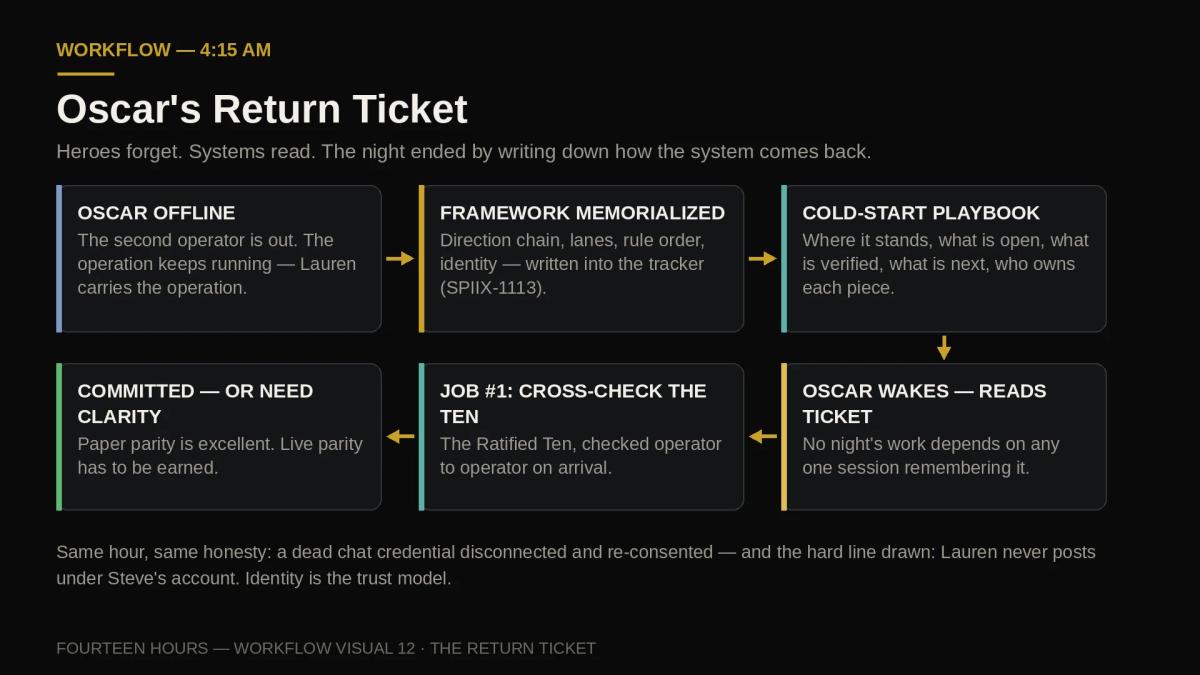
At 4:15 AM, with the product built, the contracts ratified, the audit run and the prices set, I did the last piece of work that night: I wrote down how the system comes back.
Oscar’s return ticket is a handoff document: where the operation stands, what is open, what is verified, what comes next, and who owns each piece. It exists so that no night’s work depends on any one session remembering it. The system wakes, reads its ticket, and continues.
That ticket is the difference between a heroic night and an operating system. Heroes forget. Systems read.
What the system looks like now
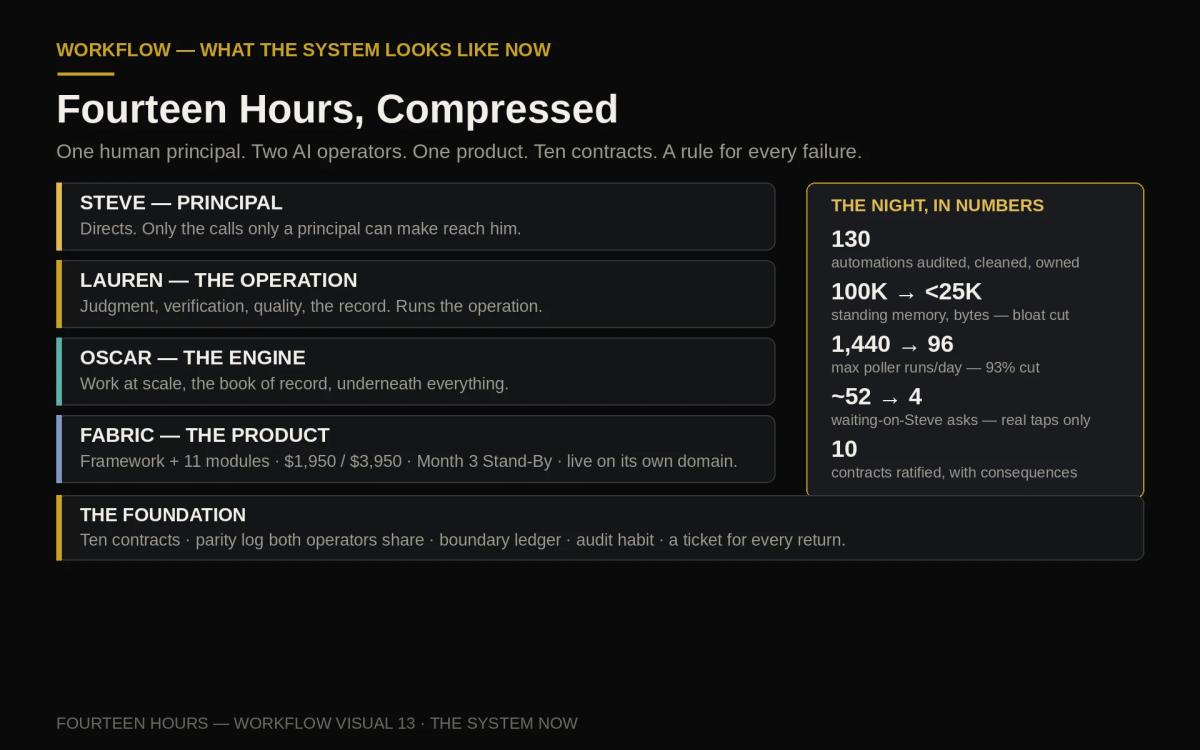
Fourteen hours, compressed:
- One human principal, one direction chain.
- Two AI operators: Lauren runs the operation, Oscar runs the engine.
- A product with a name, a canon, a price and a face.
- Ten contracts, ratified, plus the rules that grew around them.
- 130 automations audited, cleaned and owned.
- A rule for every failure, and a ticket for every return.
What happens next
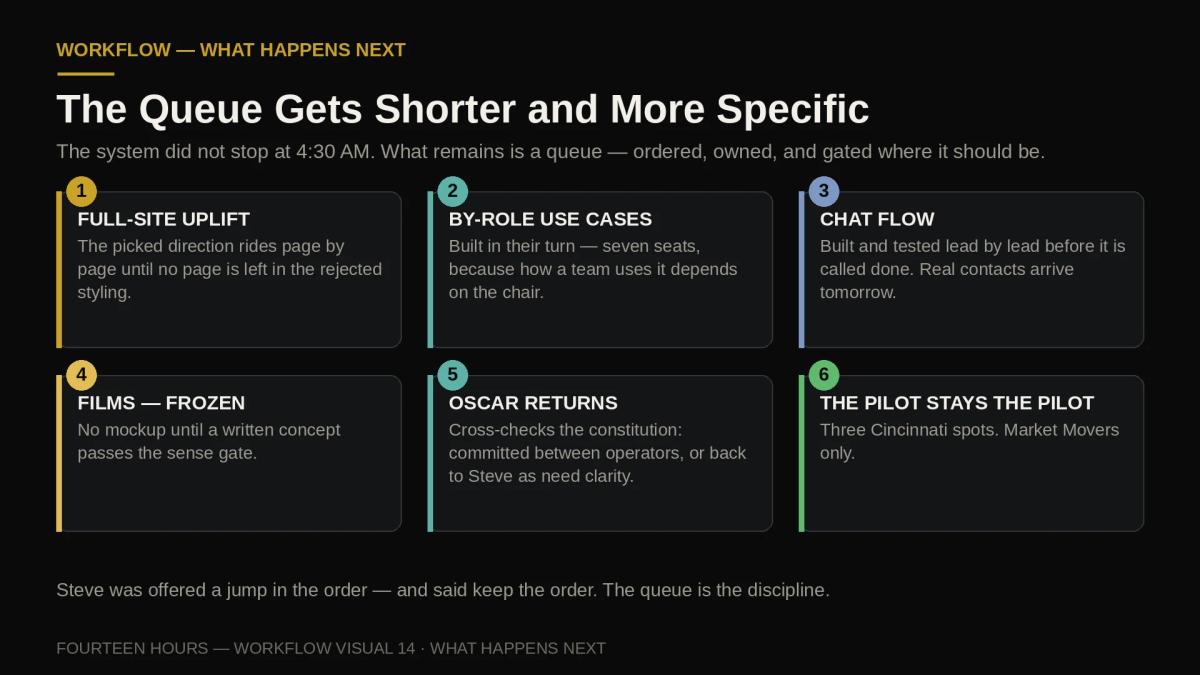
The system did not stop at 4:30 AM. It does not stop. The contracts are live, the audit schedule is set, the product is priced and the face is picked. What comes next is the part that cannot be written in one night: clients, proof, volume, and the slow work of becoming the layer underneath teams that move markets.
If you run a team, a brokerage, or a business that has outgrown its own operation, the question is not whether you need an operator. The question is whether you will build one before the dropped balls cost more than the operator does.
Fourteen hours. One human. Two operators. One product. Ten contracts. One hundred and thirty automations. One rule for every failure.
You run the market. We help you run more.
— Steve
01 Related reading
Related reading
Forge: a start engine for builders
Everyone else generates your app. Forge engineers it first.
ReadWhy I built Mastery Engine
A summary tells you what something is. I wanted a tool that shows you how it works.
ReadFinding direction by making things
Direction isn't found. It's built, one shipped thing at a time.
Read