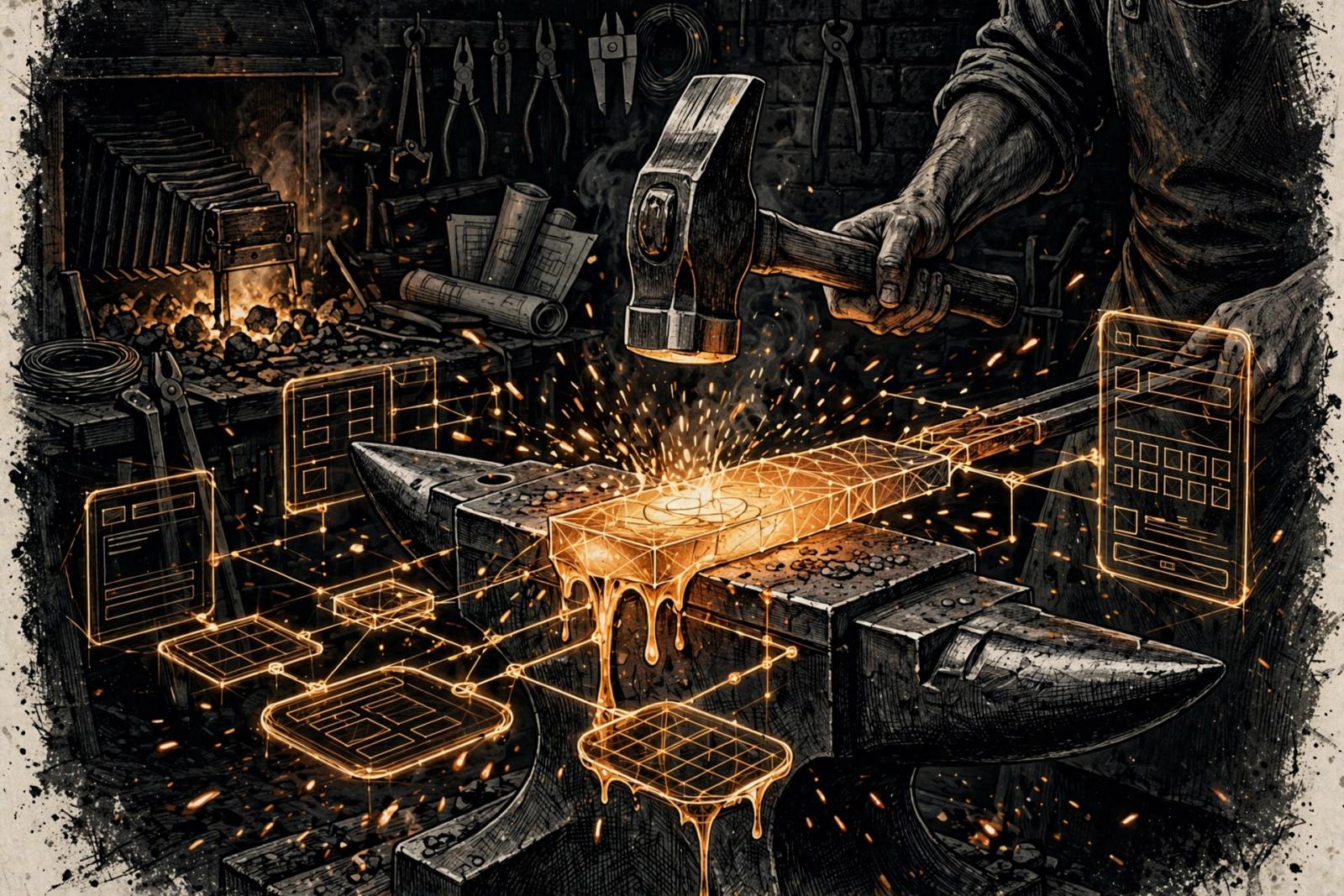
“Everyone else generates your app. Forge engineers it first.”
That’s the line. Here’s what sits behind it.
The last two years taught everyone to generate. Type a prompt, get an app. The demo is magic. The morning after is masonry — no foundation, no structure, nothing holding the walls up. A generated app is a sketch that learned to run.
Generation is not engineering. Engineering starts earlier, with the decisions that determine whether the thing survives contact with reality: what are we actually building, what’s the smallest version that matters, what has to be true on day one for it to work on day one hundred.
Forge is a start engine for builders. It runs a loop:
Generate → Connect → Prioritize → Maintain.
Generate the raw material — ideas, fragments, half-formed features. Connect them to the builder’s actual stack, actual constraints, actual users. Prioritize the MVP steps from the setup perspective — not the demo perspective. Then maintain the process, because the build isn’t the end. It’s where the real work starts.
The part I’m most interested in: default frameworks and logic, tuned to the builder. Not a blank canvas, not a rigid template — defaults that reshape around who’s building. A solo dev gets different defaults than a first-time founder. The tool learns the builder’s shape, and the builder stops fighting the tool.
And the home for all of it: a per-builder operator. A face on the machinery. Setup that’s walked, not documented. A dashboard with templated prompts, branding, a progress bar you can actually read. A products page as public proof — the work, shipped, where everyone can see it.
The design ethos, as a feeling rather than a spec: heat means change. Show the machinery. Weight. Spark → shape → edge. Craft over chrome.
This is a concept right now, not a product. I’m writing it down because the idea is clear enough to be argued with — and that’s the test I use. If you can’t write the vision plainly, you don’t have one yet.
More as it becomes real.
01 Related reading
Related reading
Fourteen Hours
Between Thursday afternoon and Friday at 4:30 AM, one human and two AI operators took stock of an entire operation, invented a product, rejected its face three times, rewrote its pricing twice, ratified ten contracts, audited 130 automations, broke the site, caught it ourselves, and wrote the rule that stops it happening again. The whole record — decisions, failures, and what the system looks like now.
ReadWhy I built Mastery Engine
A summary tells you what something is. I wanted a tool that shows you how it works.
ReadFinding direction by making things
Direction isn't found. It's built, one shipped thing at a time.
Read